
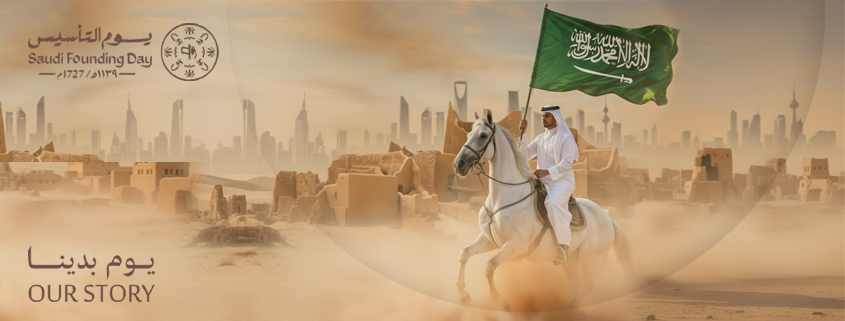
Saudi Founding Day is a national occasion celebrated every year on February 22 in the Kingdom of Saudi Arabia. This important day commemorates the founding of the First Saudi State in 1727 by Imam Muhammad bin Saud in the historic town of Diriyah. It marks the beginning of a political and cultural legacy that laid the foundations for the modern Kingdom of Saudi Arabia.
Historical Background
The story of Saudi Founding Day dates back nearly three centuries. In 1727, Imam Muhammad bin Saud established a unified political entity in Diriyah, bringing stability and security to the region. At that time, the Arabian Peninsula faced political fragmentation and tribal conflicts. The establishment of the First Saudi State introduced a new era of unity, governance, and economic growth.
Diriyah became the capital of the First Saudi State and a center of knowledge, trade, and culture. The leadership focused on spreading stability, strengthening social cohesion, and promoting Islamic values. This period represented the first step in a long journey that would eventually lead to the formation of the modern Saudi state.
The Three Saudi States
Saudi Founding Day does not only commemorate one historical moment; it celebrates the deep roots of the Saudi state across three major phases:
-
The First Saudi State (1727–1818) – Founded in Diriyah, it established the foundation of governance and unity.
-
The Second Saudi State (1824–1891) – Re-established in Riyadh, it continued the legacy despite political challenges.
-
The Third Saudi State – Founded by King Abdulaziz Al Saud in 1902, which eventually led to the unification of the Kingdom of Saudi Arabia in 1932.
Each stage reflects resilience, determination, and strong leadership that contributed to building the nation as it stands today.
Cultural and National Significance
Saudi Founding Day highlights the Kingdom’s deep historical roots that extend far beyond the unification in 1932. While Saudi National Day celebrates the official unification of the Kingdom, Founding Day emphasizes the earlier origins of the Saudi state in the 18th century.
The day is celebrated with cultural events, historical exhibitions, traditional performances such as the Ardah dance, poetry readings, and educational programs. Citizens wear traditional clothing that reflects the heritage of different regions of Saudi Arabia. The celebration strengthens national pride and reminds younger generations of their rich history.
Diriyah: The Birthplace of the Nation
Diriyah holds a special place in Saudi history. It is home to the At-Turaif district, a UNESCO World Heritage Site, symbolizing the architectural and political heritage of the First Saudi State. Today, Diriyah is being developed as a major cultural and historical destination, connecting the past with the future.
Values Reflected in Founding Day
Saudi Founding Day represents key national values:
-
Unity and stability
-
Leadership and vision
-
Cultural pride
-
Commitment to development
-
Preservation of heritage
It serves as a reminder that the strength of the Kingdom lies in its deep historical roots and strong national identity.
Conclusion
Saudi Founding Day is more than a historical anniversary; it is a celebration of identity, heritage, and continuity. By honoring the foundation laid in 1727, the Kingdom of Saudi Arabia acknowledges its long journey of growth and transformation. The day inspires citizens to take pride in their past while working confidently toward the future under the leadership of the Kingdom.
Through this annual celebration, Saudis reflect on nearly 300 years of history, unity, and progress — a story that continues to shape the nation today.
